 EN

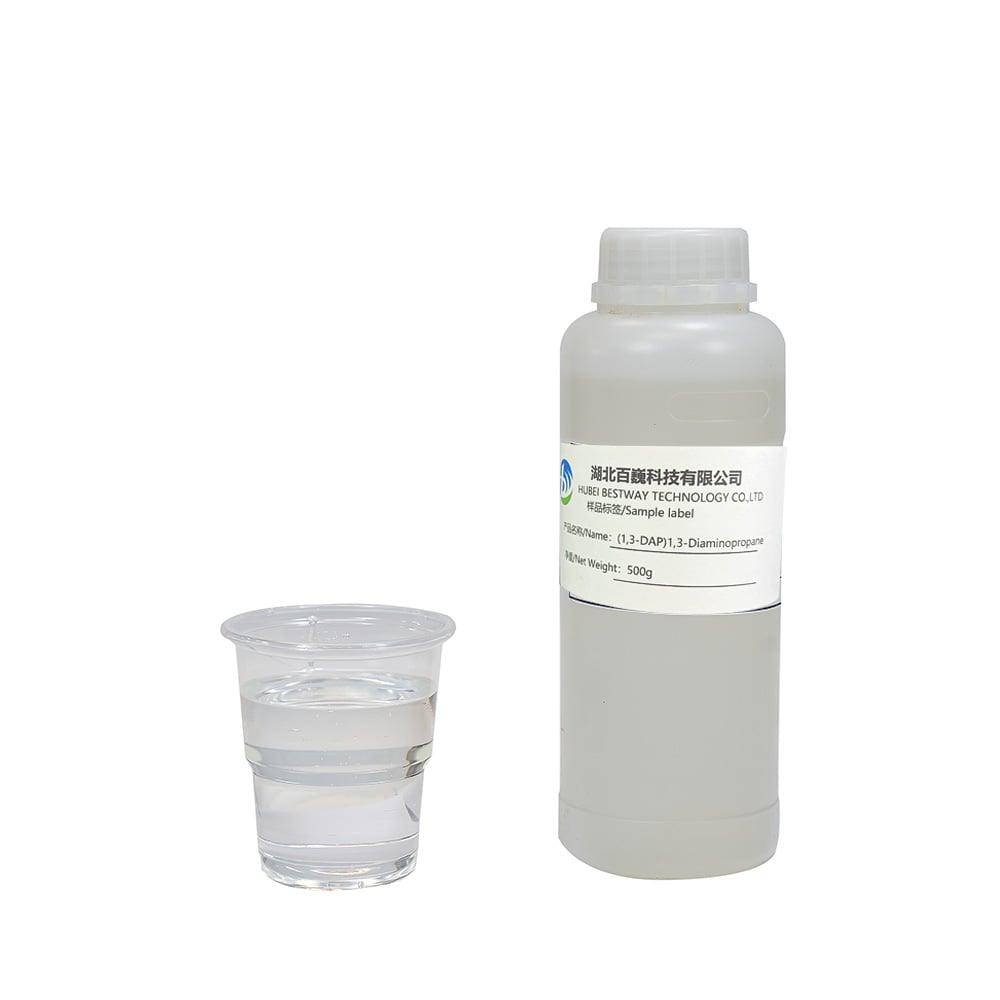
What Is 1,3-Diaminopropane?
1,3-Diaminopropane has CAS number 109-76-2, molecular formula C3H10N2, and a molecular weight of approximately 74.1 g/mol. Its two terminal primary amino groups make it useful as a building block in reactions that form heterocycles, salts, amides, and other nitrogen-containing derivatives.
The material should be evaluated as a synthesis intermediate rather than as a universal ready-to-use additive. Its performance depends on the downstream reaction, formulation, stoichiometry, impurities, water content, and processing conditions.
Main Industrial Applications of 1,3-DAP
Pharmaceutical and Agrochemical Synthesis
Hanepoxy lists 1,3-DAP as a raw material for the synthesis of medicines and pesticides. In these applications, buyers should define the required purity profile and control water and trace impurities according to the downstream process.
The use of 1,3-DAP in a pharmaceutical synthesis route does not automatically make the supplied material pharmaceutical grade. Quality-system requirements, impurity limits, traceability, and regulatory documentation must be agreed separately for each project.
Paper, Textile, and Leather Auxiliaries
1,3-DAP can be used as an intermediate in the manufacture of functional additives for paper, textile, and leather processing. Its exact role depends on the derivative being produced and the intended end-use performance.
Buyers should request application-specific information and confirm compatibility through laboratory trials before introducing a new raw material into an established production process.
Specialty Chemical Intermediates
Because 1,3-DAP is a reactive diamine, it may be evaluated in the synthesis of specialty amines, resin intermediates, surfactant intermediates, and corrosion-inhibitor derivatives.
These applications require route-specific validation. The molecular structure alone does not prove that neat 1,3-DAP will deliver a particular epoxy cure speed, glass-transition temperature, adhesion level, or chemical resistance.
Key 1,3-Diaminopropane Specifications to Request
| Parameter | Why It Matters | Buyer Action |
|---|---|---|
| Product identity | Confirms that the offered material is 1,3-diaminopropane rather than a similarly named aminopropyl compound | Match the product name, CAS number, and molecular formula across the quotation, SDS, TDS, and CoA |
| Assay or purity | Affects stoichiometry, yield, odor, color, and side reactions | Request the analytical method and lot-specific result rather than relying on a generic grade label |
| Water content | Can affect moisture-sensitive reactions and active-equivalent calculations | Specify an agreed test method, such as Karl Fischer titration, and a project-specific limit |
| Color and appearance | May indicate oxidation, contamination, or storage history | Define the required test method and acceptance limit |
| Trace impurities | Requirements vary among industrial, agrochemical, and pharmaceutical-intermediate uses | Request a chromatogram or impurity profile when the downstream process is sensitive |
| Packaging and storage | Amines can absorb moisture and carbon dioxide and require controlled handling | Confirm approved packaging, shelf life, storage temperature, and handling instructions in the current SDS |
How to Qualify a 1,3-DAP Supplier
-
Define the downstream reaction and the impurities that could interfere with it.
-
Request the current TDS, SDS, and lot-specific certificate of analysis.
-
Test a representative sample under the actual reaction and purification conditions.
-
Confirm packaging, shelf life, lead time, minimum order quantity, and export documentation.
-
Approve the material against an agreed specification before scaling up production.
Safety, Handling, and Transport
1,3-DAP is a reactive amine that requires suitable engineering controls, personal protective equipment, and segregated storage. Containers should remain closed and should be protected from incompatible materials and environmental conditions identified in the supplier SDS.
Transport classification, UN number, packing group, and packaging requirements must be confirmed from the current SDS for the exact shipped product, concentration, destination, and transport mode.
Frequently Asked Questions
Is 1,3-diaminopropane the same as 1,3-propanediamine?
Yes. These names refer to the same base substance when the CAS number is 109-76-2. Buyers should still verify the full identity because other aminopropyl compounds have similar names.
Can 1,3-DAP be used directly as an epoxy curing agent?
Its amino groups can react with epoxides, but commercial suitability cannot be inferred from structure alone. Formulators must evaluate stoichiometry, exotherm, pot life, cure completeness, volatility, mechanical properties, and the safety profile of the complete system.
What documents should a buyer request?