 EN
EN

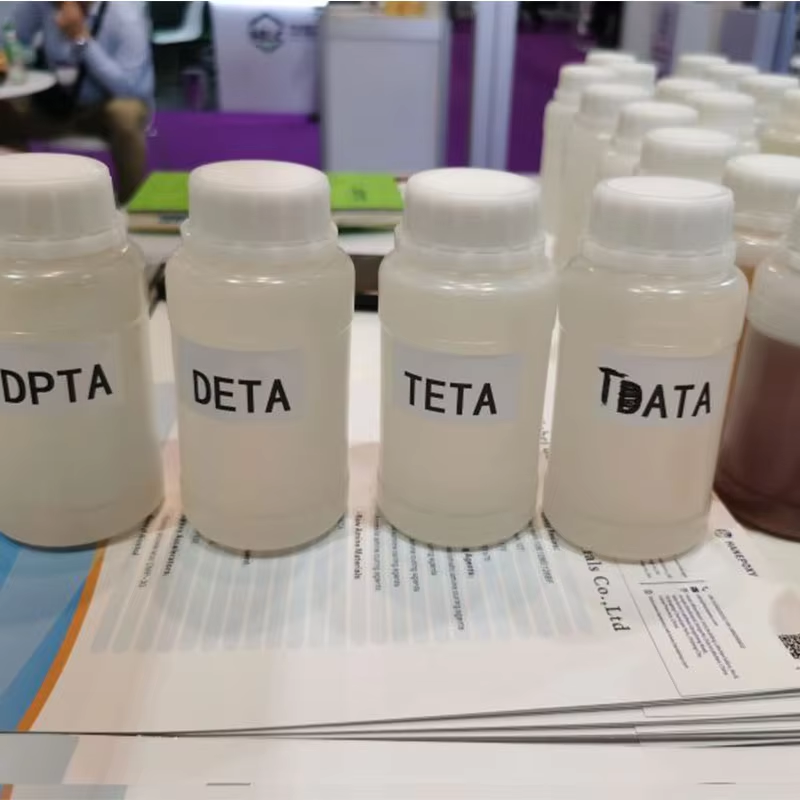
How Aliphatic Amine Structure Governs Epoxy Ring-Opening Reactivity
Primary vs. secondary amines: nucleophilicity, proton transfer efficiency, and catalytic role in epoxy curing
Primary amines have two reactive hydrogens attached to each nitrogen atom, which makes them much more reactive when it comes to opening epoxy rings compared to secondary amines. The reason? They're better nucleophiles and can stabilize those tricky transition states through double hydrogen bonding. When the nitrogen center isn't blocked, these molecules can quickly attack strained epoxy rings. Plus, the internal proton transfer happens so efficiently that covalent bonds form faster. Tests show primary amines work about twice as fast under the same conditions as their secondary counterparts. Secondary amines do help extend chains, but those nearby alkyl groups get in the way, making adduct formation slower. Tertiary amines operate differently altogether. Instead of joining the polymer network, they speed up the curing process by removing protons from hydroxyl intermediates created during ring opening. This lets other epoxy attacks happen quicker. Understanding how these different amine types behave matters a lot in practice because it affects things like gel time, how dense the cross-links become, and ultimately what kind of material structure gets formed in actual industrial applications.
Steric and conformational effects: chain length, branching, and cycloaliphatic substitution in DETA, TETA, and IPDA
The way molecules are put together really affects how they react and perform in practice. Take linear polyamines for example - substances like diethylenetriamine (DETA) and triethylenetetramine (TETA) have these long, flexible chains with lots of amine groups along them. This setup lets them cross link pretty quickly even at room temperature, which makes them great for fast production processes where coatings and adhesives need to set up rapidly. On the flip side, something like isophoronediamine (IPDA) has this rigid double ring structure that gets in the way of its amine groups. The result? About 40% slower reaction times compared to DETA when those rings open up. But there's a benefit here too. Those tight structures actually make IPDA stand up better to heat (over 200 degrees Celsius), chemicals, and UV light once it's fully cured. Then we get to branched structures such as aminoethylpiperazine. These compounds sit somewhere between the extremes. They don't evaporate as easily as linear ones and tend to be tougher materials overall, but they still maintain decent reactivity levels without being too slow like the most constrained systems. For people who formulate these materials, understanding these structural differences means they can adjust properties like how fast something cures, how strong it becomes, and how well it holds up against different environmental conditions across all sorts of applications from protective coatings to composite materials and electronic encapsulation.
Temperature-Driven Cure Kinetics of Aliphatic Amine–Epoxy Systems
Temperature critically modulates the reactivity dynamics between aliphatic amine hardeners and epoxy resins–dictating processing windows, network homogeneity, and final property development. Understanding these thermal dependencies enables robust, scalable curing protocols across manufacturing environments.
Exotherm evolution and gel time shifts across thermal profiles: from ambient to 60°C isothermal conditions
When temperatures go up, chemical reactions speed up too, which means heat gets released faster. This pushes those exothermic peaks to happen sooner and makes the gelation window shrink quite a bit. Take a standard DETA-epoxy setup as an example. At room temperature around 25 degrees Celsius, we usually see the peak exotherm somewhere around 120 minutes later, with temperatures spiking about 80 degrees. But crank that temperature to 60 degrees Celsius, and suddenly the peak hits in just 45 minutes flat. What's even more interesting is that nearly 92% of all the heat from the reaction has already been released within an hour at that higher temperature. The gel time drops off dramatically as things heat up. For every 10 degree jump in temperature, the gel time basically cuts in half because molecules move around more and bump into each other more often. Still, there are risks when things get too hot. If the temperature climbs past 130 degrees Celsius without control, especially in thicker parts being cast, the material can start breaking down thermally. That's why most manufacturers stick to staged heating processes or carefully controlled temperature increases. Doing so helps create a more uniform structure throughout the material while preventing those pesky internal stresses and air pockets that nobody wants.
Activation energy trends via isoconversional DSC analysis: linking amine structure to thermal sensitivity
When we look at Isoconversional Differential Scanning Calorimetry (DSC), it actually tells us something pretty interesting about how molecules respond to heat. Take those straight-chain aliphatic amines like TETA for instance they typically have activation energies around 55 to 60 kJ per mole. That means there's not much stopping them from reacting when heated, and their response is really dependent on temperature changes. On the flip side, cycloaliphatic amines such as IPDA need way more energy to get going usually over 70 kJ/mol because their ring structures make it harder to reach the epoxy groups. What's fascinating though is what happens with IPDA early on in the reaction process. The Friedman method has shown that its activation energy actually drops by about 15 to 25 percent when conversion is still under 20%. This suggests these materials react better at lower temps than what average numbers would predict. And this difference in thermal behavior helps explain why some high energy systems need serious heating just to finish curing at room temp, while those lower energy linear amines can sometimes cure completely even if the temperature dips below 15 degrees Celsius, as long as moisture levels and chemical ratios stay within tight limits.
❓ Methodology Note: Isoconversional DSC calculations track energy barriers at fixed degrees of conversion, avoiding mechanistic assumptions and delivering more reliable kinetic models for complex, multi-step epoxy–amine reactions.
Practical Reactivity Comparison of Common Aliphatic Amines in Industrial Curing Scenarios
The performance characteristics of aliphatic amines play a major role in how well they work in industrial epoxy formulations. Take Diethylenetriamine (DETA) and Triethylenetetramine (TETA) for instance these compounds cure much faster at room temperature about 30 to 40 percent quicker than their aromatic counterparts which means shorter pot life but allows manufacturers to keep production lines moving quickly. However there's a tradeoff here. Their linear molecular structure creates strong cross links but makes them prone to absorbing moisture from the air. This can lead to problems like carbamate formation, surface discoloration, and weaker bonding over time. Isophoronediamine (IPDA) handles this differently thanks to its unique cyclohexyl ring structure that acts as a sort of shield against moisture absorption. As a result, IPDA offers better resistance to humidity, maintains clearer finish, and provides good protection against corrosion making it especially useful in marine environments and architectural applications where appearance matters. One thing to note though is that IPDA doesn't perform so well when temperatures drop below 15 degrees Celsius while DETA and TETA still work reasonably well down to around 5 degrees. When choosing between these hardeners, manufacturers need to weigh several factors including how fast they need the material to cure, what kind of environmental conditions it will face, temperature ranges during application, and ultimately what the finished product needs to do. For projects where speed is essential, DETA and TETA are usually the go to options. But if the application requires long lasting durability, looks that stay put, or has unpredictable weather conditions, then IPDA tends to be the better choice despite its temperature limitations.
FAQ Section
What are aliphatic amines, and how do they affect epoxy curing?
Aliphatic amines are organic compounds where nitrogen atoms are bonded to hydrocarbon chains. They influence epoxy curing by acting as hardeners that open epoxy rings, leading to the formation of cross-linked polymer networks.
How do primary, secondary, and tertiary amines differ in their reactivity with epoxy rings?
Primary amines are the most reactive due to their nucleophilicity and efficient proton transfer, making them effective at epoxy ring opening. Secondary amines have slower reactivity due to steric hindrance. Tertiary amines primarily act as catalysts, removing protons and increasing curing speed without directly forming covalent bonds.
Why is temperature important in aliphatic amine–epoxy systems?
Temperature is crucial because it speeds up chemical reactions, affects exotherm evolution, shifts gel time, and influences the final properties of the cured material. Controlled temperature protocols can help avoid material breakdown and ensure uniform network formation.
Are linear or cycloaliphatic amines better for industrial applications?
Both have unique advantages—linear amines like DETA and TETA cure faster but absorb moisture, while cycloaliphatic amines like IPDA offer better resistance to humidity and corrosion but may require higher temperatures for curing.