 EN
EN

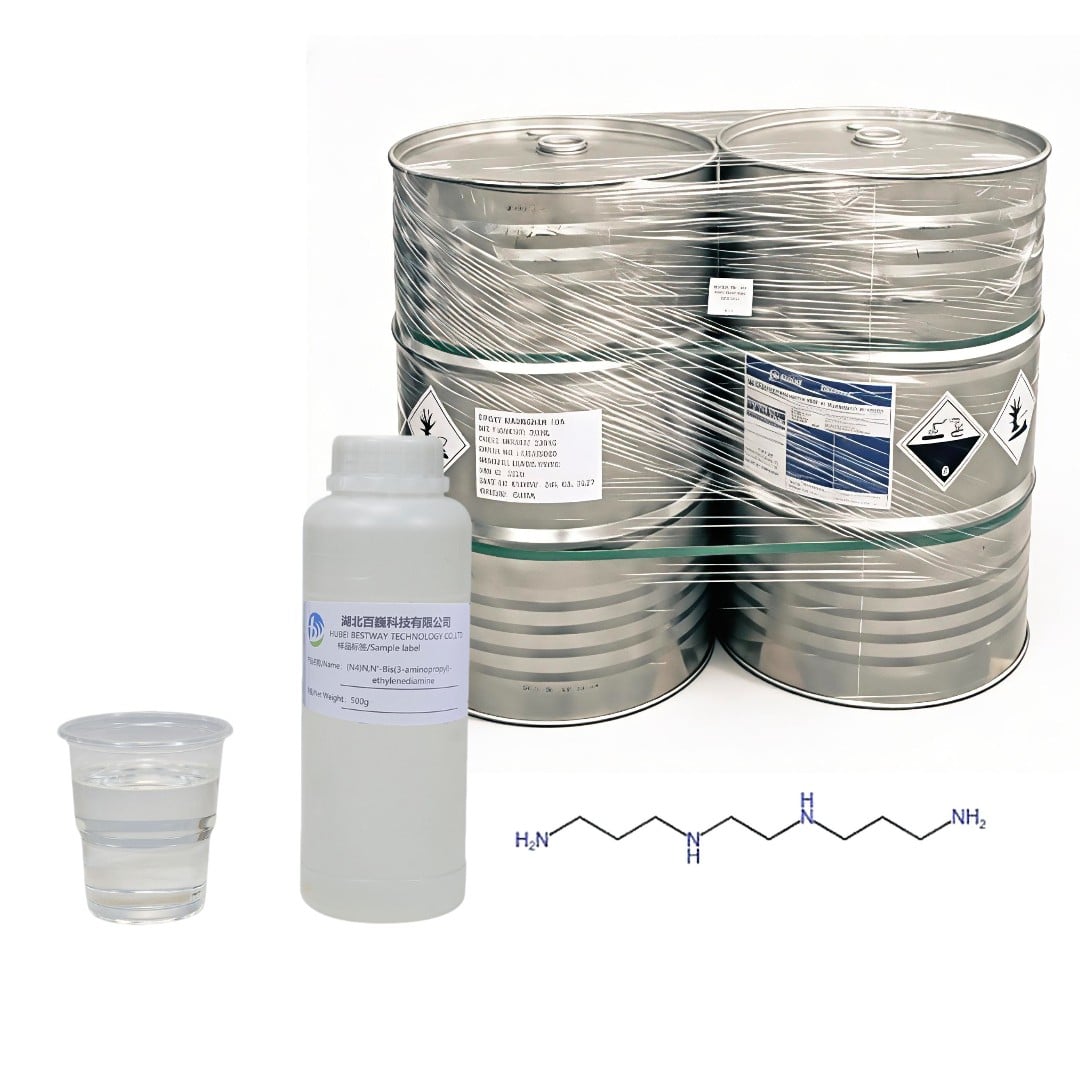
The molecular-weight difference and the aminopropyl architecture of TATA can shift stoichiometric demand, curing behavior, viscosity response, exotherm, and final epoxy film properties. Buyers should treat TATA as a formulation alternative, not as a direct drop-in replacement for TETA.
Key comparison for RFQ screening
-
TETA: triethylenetetramine, C6H18N4, molecular weight 146.
-
TATA/N4 Amine: N,N'-Bis(3-aminopropyl)ethylenediamine, CAS 10563-26-5, C8H22N4, molecular weight 174.2.
-
TATA supplier TDS data: transparent colorless liquid, APHA color ≤30, viscosity <30 mPa·s at 25°C, amine value 1287 ±20 mgKOH/g, purity ≥97%, density 0.93–0.97 g/cm³ at 25°C, moisture content ≤0.5%, packaging 190 kg/drum.
Before bulk purchase: compare active hydrogen equivalent weight, amine value, viscosity, gel time, SDS, COA, and sample test results in the buyer's actual epoxy formulation.
1. Chemical identity and specification comparison
The two products differ at the raw-material level. TETA is triethylenetetramine, with molecular formula C6H18N4 and molecular weight 146. TATA/N4 Amine is N,N'-Bis(3-aminopropyl)ethylenediamine, CAS No. 10563-26-5, with molecular formula C8H22N4 and molecular weight 174.2.
| Parameter | TETA | TATA (N4 Amine) |
|---|---|---|
| Chemical name | Triethylenetetramine | N,N'-Bis(3-aminopropyl)ethylenediamine |
| CAS No. | Confirm with supplier | 10563-26-5 |
| Molecular formula | C6H18N4 | C8H22N4 |
| Molecular weight | 146 | 174.2 |
| Appearance | Confirm with supplier | Transparent colorless liquid |
| Color | Confirm with supplier | APHA ≤30 |
| Viscosity at 25°C | Confirm with supplier | <30 mPa·s |
| Amine value | Confirm with supplier | 1287 ±20 mgKOH/g |
| Purity | Confirm with supplier | ≥97% |
| Density at 25°C | Confirm with supplier | 0.93–0.97 g/cm³ |
| Moisture content | Confirm with supplier | ≤0.5% |
| Packaging | Confirm with supplier | 190 kg/drum |
Values in the TATA column come from the supplier TDS. For TETA, request batch COA data instead of assuming a generic specification; isomer profile and moisture history can vary by lot.
2. Structural differences that affect curing ratio and formulation design
Both products are linear tetraamines, but the backbone differs. TETA has short ethylene bridges between nitrogen atoms. TATA has two aminopropyl terminal groups on a central ethylenediamine segment, raising molecular weight from 146 to 174.2.
That structural difference affects stoichiometry. Assuming six active amine hydrogens from two primary amines and two secondary amines, TETA gives roughly 146/6 ≈ 24.3 g/eq and TATA gives roughly 174.2/6 ≈ 29.0 g/eq. A formulation designed for TETA may require a different mass ratio if TATA is substituted. The supplier TATA TDS amine value of 1287 ±20 mgKOH/g provides a useful cross-check, but the buyer should still confirm the practical active hydrogen equivalent weight from the COA.
Cured epoxy network density can be regulated by selecting appropriate epoxy monomers and amine hardeners once stoichiometric balance is achieved. Because TETA and TATA have different equivalent weights, a small ratio error can change crosslink density, hardness development, chemical resistance, and film flexibility.
3. Pot life, exotherm, viscosity, and final epoxy performance
Aliphatic primary amines cure fast at room temperature but have poor elevated-temperature resistance and high exotherm. TETA belongs to this family. Aliphatic amines remain the most common industrial curing agents, with ethyleneamines such as TETA and TEPA among prominent examples.
Aliphatic amine systems typically show short pot life and fast film drying compared with cycloaliphatic, aromatic, and polyamide alternatives. TETA and TATA both fall into this category, but pot life and exotherm are not identical across the two. TATA's higher molecular weight and longer aminopropyl spacers may moderate exotherm or shift gel time. The direction of that shift depends on resin EEW, hardener ratio, film thickness, and cure schedule.
The aminopropyl segments in TATA may alter flexibility compared with TETA's shorter ethylene bridges. Whether that shift is beneficial depends on the required balance of hardness, flexibility, and chemical resistance. Run side-by-side measurements of gel time, peak exotherm, through-cure, film hardness, and flexibility before qualifying a switch.
In adduct chemistry, N4-amine is referenced as a preferred polyalkylene amine alongside TETA, TEPA, and PEHA where pigment wetting and cure rate are important. It also appears in broader candidate lists with DETA, TETA, IPDA, and related amine curatives. These references support specialty amine monomer use, but not interchangeability without formulation validation.
4. Applications for TETA and TATA/N4 Amine in epoxy and industrial formulations
Aliphatic amine compounds are common curing agents for epoxy resin thermosets. Nucleophilic reactivity varies among aliphatic, cycloaliphatic, and aromatic amines. Amine adduct reactions frequently use diethylenetriamine, triethylenetetramine, tetraethylenepentamine, isophorone diamine, bis-para-aminocyclohexyl methane, and 1,2-diaminocyclohexane.
TETA is widely referenced as a standard aliphatic amine curing agent and synthesis intermediate. TATA/N4 Amine fits the same broad application envelope as an aliphatic amine monomer for:
-
Epoxy curing agents and hardener formulations
-
Polyamide or polyamidoamine resin production
-
Coating auxiliaries and specialty amine adducts
-
Specialty chemical intermediates
For projects with bio-based raw-material requirements, bio-based amine sources have been reported from vegetable oils, sugar products, chitosan, and amino acids. These are a separate evaluation track from petroleum-based TETA and TATA, and they require supplier-specific qualification. Confirm bio-based content, purity, amine value, and performance with the supplier before comparing them to TETA or TATA.
5. Procurement checklist: RFQ specifications, COA, and sample testing
A practical RFQ should go beyond a trade name and unit price. Specify the exact CAS, chemical name, and the following lot-level data:
-
Purity, amine value, active hydrogen equivalent weight, and moisture content
-
Color, viscosity, and density at the relevant test temperature
-
Gel time and pot life in the buyer's reference epoxy resin
-
Peak exotherm and film drying behavior at the intended cure schedule
-
SDS and batch COA from the current production lot
-
Packaging and closure: TATA TDS lists 190 kg/drum; confirm pallet configuration and label requirements
-
Sample availability for pre-qualification
Do not treat TATA as a drop-in replacement for TETA without stoichiometric and performance verification. Before substitution, test AHEW, amine value, viscosity, gel time, exotherm, film hardness, flexibility, and chemical resistance in the target system.
| Decision question | Buyer action |
|---|---|
| Is TATA a direct drop-in for TETA? | No. Different molecular weight, structure, amine value, and likely cure profile. Require testing. |
| What should be compared before purchase? | AHEW, amine value, viscosity, moisture, APHA color, purity, gel time, exotherm, COA, SDS, and sample results. |
| What if the application needs fast room-temperature cure? | Both are aliphatic amine options, but confirm gel time and exotherm in the specific formulation. |
| What if the buyer has a qualified TETA formulation? | Keep TETA as the control and run TATA/N4 Amine as a side-by-side alternative, not as an automatic replacement. |
| What packaging should be specified? | For TATA, supplier TDS lists 190 kg/drum. Confirm closure, label, and transport requirements. |
6. FAQ
Is TATA/N4 Amine a direct replacement for TETA? No. TATA is N,N'-Bis(3-aminopropyl)ethylenediamine with molecular formula C8H22N4 and molecular weight 174.2. TETA is triethylenetetramine with molecular formula C6H18N4 and molecular weight 146. The higher molecular weight and aminopropyl structure can change hardener demand, viscosity response, gel time, exotherm, and final film properties. TATA should not be used as a drop-in replacement without formulation testing.
What are the key TATA/N4 Amine specifications? From the supplier TDS, TATA/N4 Amine is a transparent colorless liquid with APHA color ≤30, viscosity <30 mPa·s at 25°C, amine value 1287 ±20 mgKOH/g, purity ≥97%, density 0.93–0.97 g/cm³ at 25°C, moisture content ≤0.5%, and packaging in 190 kg/drum units. CAS No. is 10563-26-5.
Which product gives longer pot life: TETA or TATA/N4 Amine? Aliphatic amines as a class have short pot life relative to cycloaliphatic or polyamide hardeners. Both TETA and TATA fall into the aliphatic amine family. TATA's higher molecular weight and longer aminopropyl structure may shift gel time in a specific formulation. Request gel time and exotherm data in your own resin system rather than assuming one product always gives longer pot life.
What should procurement request from suppliers before bulk purchase?