 EN
EN

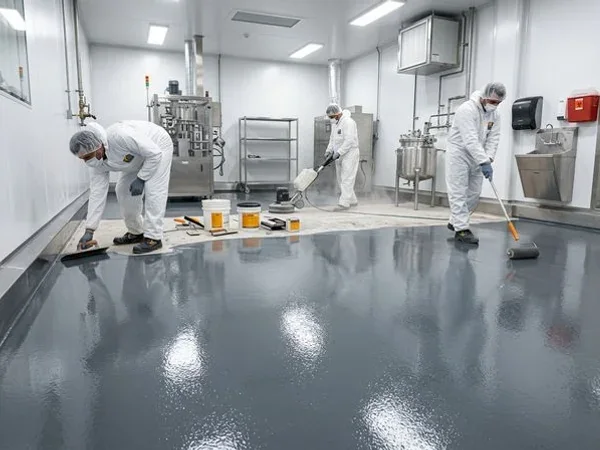
This guide is written for paint and coating formulators, technical managers, and raw-material procurement teams. It does not tell contractors how to prepare or install a floor. Instead, it explains how end-use requirements—such as substrate moisture, application temperature, traffic, chemical exposure, and return-to-service time—should be translated into raw-material selection and qualification tests.
| Formulation layer | Primary raw-material objective | Typical development questions |
|---|---|---|
| Primer | Low viscosity, concrete wetting, adhesion, controlled penetration | Does the mixed system wet the substrate without draining into pores or trapping air? |
| Filled body coat | Filler acceptance, workable rheology, impact-bearing film build | How much quartz or silica can the binder accept while retaining application consistency? |
| Self-leveling topcoat | Flow, gloss, blush resistance, hardness development | Does the film level before gelation and cure without haze, tack, or surface defects? |
Start with the Formulation Brief, Not a Resin Trade Name
Before comparing resin grades, the formulator should define the service and processing window. A warehouse topcoat, a damp-substrate primer, and a chemically exposed production floor may all be called “industrial epoxy flooring,” but they should not share an unexamined binder package.
The formulation brief should state:
-
target layer: primer, body coat, self-leveling topcoat, or repair mortar;
-
application method and target film thickness;
-
filler type, particle-size distribution, and intended loading;
-
ambient and substrate temperature range during application and cure;
-
required pot life, recoat window, early hardness, and full-cure time;
-
expected exposure to water, cleaning agents, oils, acids, alkalis, or solvents;
-
appearance requirements, including color, gloss, leveling, and blush resistance;
-
required mechanical tests, such as adhesion, abrasion, impact, compressive strength, or Shore D hardness.
Site conditions still matter, but they matter here as formulation inputs. Concrete moisture and outgassing, for example, affect primer design and qualification. They do not justify turning a raw-material article into a contractor’s surface-preparation manual. A coating manufacturer should reproduce relevant substrate risks in controlled panels and application trials, then issue installation limits in the finished system’s own TDS.
Choosing the Epoxy Backbone and Viscosity Package
Standard Bisphenol-A liquid epoxy is the usual starting point for general-purpose flooring binders because it offers a practical balance of availability, mechanical performance, and formulation flexibility. Bisphenol-F grades can be evaluated when lower viscosity or higher functional density is useful. Novolac epoxy belongs in development programs where the finished formulation must pass a defined chemical-exposure requirement; the resin family alone is not proof of chemical resistance.
The Hanepoxy catalogue lists the following candidates for formulation screening:
| Grade | Catalogue description | EEW (g/eq) | Viscosity at 25°C (mPa·s) | Formulation screening direction |
|---|---|---|---|---|
| 128 | Bisphenol-A liquid epoxy | 184–196 | 11,000–15,000 | General binder candidate for body coats and topcoats |
| 128E | Bisphenol-A modified with C12–C14 alkyl glycidyl ether | 190–210 | 1,000–2,500 | Reduced-viscosity candidate for wetting or higher filler loading |
| 128G | Bisphenol-A liquid epoxy | 190–210 | 700–1,300 | Low-viscosity formulation candidate |
| 128EL | Bisphenol-A liquid epoxy | 200–220 | 500–900 | Low-viscosity formulation candidate; account for its higher EEW |
| 128BF | Bisphenol-A modified with Bisphenol-F | 190–210 | 200–1,000 | Candidate where low mixed viscosity is required |
| 128M | Bisphenol-A liquid epoxy | 180–200 | 5,000–8,000 | Intermediate-viscosity binder candidate |
| 170 | Bisphenol-F liquid epoxy | 160–180 | 2,000–5,000 | Candidate for lower-viscosity, higher-functionality systems |
| 638 | Novolac epoxy | 174–180 | Confirm from current TDS | Candidate for chemical-resistance development programs |
These figures are supplier catalogue ranges, not finished-formulation guarantees. Current TDS and batch COA values should be checked before laboratory work. When moving between grades, recalculate stoichiometry from the actual EEW and re-optimize reactive diluent level, hardener dosage, filler loading, defoamer, flow additive, and pigment package.
Reduced viscosity should never be evaluated in isolation. A reactive-diluent-modified resin may improve handling and filler wetting, but it can also change crosslink density, cure response, hardness development, water uptake, and chemical resistance. The correct choice is the grade that meets the mixed-system processing window and passes the finished-film test plan—not simply the resin with the lowest neat viscosity.
Curing Agent Selection for Surface Quality and Cure Control
The hardener package determines much of the working time, hardness build, surface appearance, moisture sensitivity, and chemical performance of an epoxy floor coating. Modified cycloaliphatic amines, polyamides, and modified polyetheramines therefore serve different formulation goals rather than forming a simple good-better-best hierarchy.
Modified cycloaliphatic amines are logical candidates for self-leveling or thin-film topcoats where formulators prioritize gloss, color, hardness development, and resistance to surface blush. Polyamides are typically screened for primers and corrosion-resistant base coats where longer working time, wetting, flexibility, or surface tolerance is valuable. Modified polyetheramine hardeners can be considered when the development brief requires a different balance of flexibility, leveling, moisture resistance, and cure response.
Selected catalogue candidates include:
| Product | Chemistry direction | Amine value (mg KOH/g) | Viscosity (mPa·s) | AHEW (g/eq) | Catalogue positioning |
|---|---|---|---|---|---|
| Hanamine 1816 | Modified cycloaliphatic amine | 230–290 | 300–600 at 25°C | 114 | Epoxy floor topcoat; supplier mix-ratio guidance 100:60 |
| Hanamine 1815 | Modified cycloaliphatic amine | 280–340 | 200–500 at 25°C | 94 | Floor topcoat and cold-weather cure candidate; guidance 100:50 |
| Hanamine 1815A | Modified cycloaliphatic amine | 250–310 | 500–700 at 25°C | 106 | Floor topcoat candidate; guidance 100:58 |
| Hanamine 1815B | Modified cycloaliphatic amine | 270–330 | 200–600 at 25°C | 94 | Wear-resistant topcoat direction; listed pot life 20–30 minutes; guidance 100:50 |
| Hanamine 3327 | Modified polyetheramine | 240–300 | 200–500 at 25°C | 93 | Self-leveling or thin-coat topcoat candidate |
| Hanamine 4327 | Modified polyetheramine | 270–330 | 200–500 at 25°C | 96 | Nonylphenol-free, low-VOC, high-gloss topcoat direction |
| Hanamide 115 | Polyamide | 230–260 | 50,000–80,000 at 40°C | 180 | Primer and anticorrosive coating direction |
| Hanamide 125 | Polyamide | 270–310 | 8,000–12,000 at 40°C | 126 | Lower-viscosity polyamide screening candidate |
| Hanamide 140 | Polyamide | 320–360 | 3,000–6,000 at 40°C | 95 | Higher-amine-value polyamide screening candidate |
Catalogue mix ratios are supplier guidance for specified resin conditions; they are not universal stoichiometric ratios. Formulators should calculate the starting level from the resin EEW and hardener AHEW, then confirm it through cure, glass-transition, mechanical, and resistance testing. Amine value and AHEW are not interchangeable.
Designing a Coherent Primer, Body Coat, and Topcoat Portfolio
A commercial flooring range benefits from shared raw materials, but each layer still needs its own optimization.
For a primer, the mixed viscosity must support wetting and penetration without excessive absorption or solvent-like loss into porous concrete. Resin candidates such as 128E, 128G, 128EL, 128BF, or 170 may help establish a lower-viscosity starting point, subject to adhesion, moisture, and cure testing. A polyamide or another surface-tolerant hardener may be evaluated where the brief prioritizes working time and substrate wetting. The finished primer should be tested on representative concrete, not only on smooth laboratory panels.
For the body coat, the binder must accept the chosen quartz or silica loading while remaining mixable and applicable. The development program should record viscosity versus filler loading, sag or flow, exotherm, air release, compressive behavior, impact response, and adhesion to both primer and topcoat. Resin cost per kilogram is less informative than binder demand per square metre at the required film build.
For a self-leveling topcoat, the balance between flow time and gel time becomes critical. The film must level and release air before viscosity rises, yet develop sufficient early hardness for the intended production schedule. Modified cycloaliphatic or polyetheramine candidates should therefore be compared in the complete pigmented formulation, including fillers and additives. Neat-resin or clear-cast results cannot substitute for the actual floor-coating formula.
Raw-material commonality is useful only when it does not compromise layer performance. A manufacturer may use one base resin across several products while changing hardener, diluent, filler, and additive packages. Conversely, a specialized primer may justify a different resin if it materially improves wetting or adhesion consistency.
Qualification Data Procurement Teams Should Require
Purchasing should not approve a raw material solely because its nominal chemistry matches the incumbent. A controlled change process protects both formulation performance and production consistency.
For each resin lot, request the current TDS, SDS, and COA, including EEW, viscosity at the stated temperature, color, water or volatile content, hydrolyzable chlorine, and inorganic chlorine where relevant. For each hardener, request amine value, AHEW, viscosity, color, water content, recommended dosage range, packaging, storage conditions, and shelf life. Confirm which values are release specifications and which are typical values.
The laboratory qualification matrix should include at least:
| Test stage | Recommended comparison |
|---|---|
| Processing | Mixed viscosity, filler acceptance, dispersion behavior, air release, pot life, gel time, exotherm |
| Application | Wetting, flow, leveling, sag, film build, recoat compatibility |
| Cure | Tack-free time, walk-on or handling time, Shore D development, full-cure schedule |
| Mechanical | Adhesion, abrasion, impact, compressive behavior where relevant |
| Exposure | Water resistance, whitening or blush, and project-specific chemical spot or immersion tests |
| Production | Batch-to-batch consistency, color control, packaging, storage stability |
Can a lower-viscosity resin replace 128 without reformulation?
No automatic substitution should be assumed. A lower-viscosity grade may change EEW, reactive-diluent content, cure stoichiometry, filler demand, film properties, and chemical resistance. Treat it as a reformulation project and compare it with the qualified control.
Should one hardener be used across primer and topcoat products?
Only if it passes both briefs. Primer development may prioritize wetting and working time, while a topcoat may prioritize leveling, gloss, blush resistance, and early hardness. Shared inventory is valuable, but it should follow performance validation rather than drive it.
What information belongs in an RFQ?
State the intended formulation layer, target resin EEW or hardener AHEW range, viscosity window and test temperature, required color, packaging, annual volume, destination, documentation requirements, and sample quantity. Include the intended application and critical tests so the supplier can recommend an appropriate candidate rather than merely quote the closest product name.
From Sample Approval to Production Scale-Up
A practical sourcing sequence is straightforward: screen documents, test laboratory samples against the incumbent, produce a pilot batch, coat representative substrates, and approve the material only after the complete formulation passes its release criteria. Retain reference samples and record the exact raw-material batches used during qualification.
Hanepoxy resin and hardener grades can serve as candidates within that process. Selection should begin with the formulation brief and current technical documents, followed by controlled comparison of stoichiometry, processing behavior, cure, appearance, and service resistance. This approach gives coating manufacturers a defensible basis for cost optimization or supplier diversification without presenting a catalogue match as proof of equivalence.
For a technical review or sample request, provide the target layer, current binder chemistry, desired viscosity and cure window, filler loading, application temperature, and required performance tests. That information allows a supplier to narrow the candidate list and prepare relevant TDS, SDS, COA, packaging, and sampling details.
Engineering note: The values in this guide apply only to the cited catalogue grades and stated test temperatures. Finished performance depends on the complete resin-hardener formulation, filler loading, additives, substrate, film build, cure schedule, and test method. Confirm current specifications and validate suitability through laboratory formulation work, pilot batches, and representative application trials before scale-up.
Table of Contents
- Start with the Formulation Brief, Not a Resin Trade Name
- Choosing the Epoxy Backbone and Viscosity Package
- Curing Agent Selection for Surface Quality and Cure Control
- Designing a Coherent Primer, Body Coat, and Topcoat Portfolio
- Qualification Data Procurement Teams Should Require
- From Sample Approval to Production Scale-Up